Your AI Agents Need an HR Department
The companies stuck at Assist-level AI aren't stuck because the technology plateaued. They're stuck because nobody is doing People Operations for the agents.
Part of The Management Layer
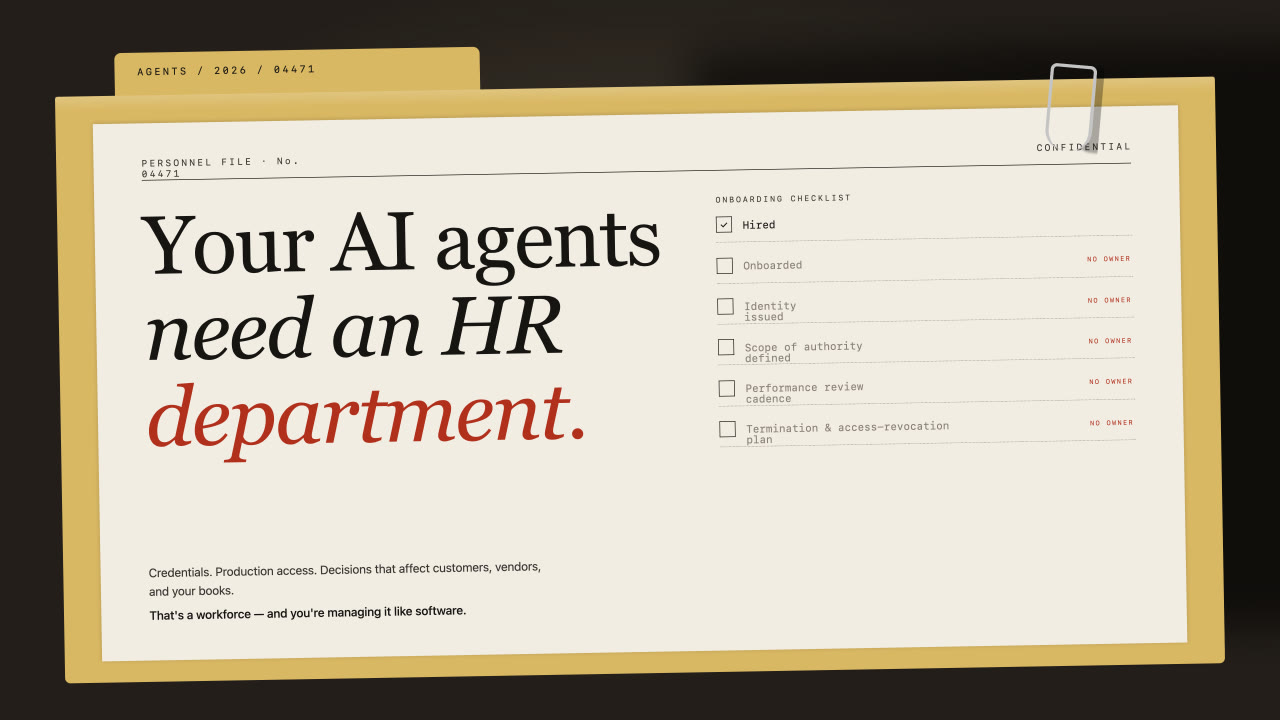
You’ve deployed AI agents. Not chat assistants people use on the side. Enterprise agents that act on behalf of your company. They draft your collection emails, process your invoices, match your payments, summarize your reports, flag your exceptions. They have credentials. They touch production systems. They make decisions that affect customers, vendors, and your books.
That’s a workforce.
And you’re managing it like software.
Software gets deployed, monitored, patched, and replaced. Workforces get hired, onboarded, coached, promoted, and occasionally fired. The companies stuck at Assist-level AI aren’t stuck because the technology plateaued. They’re stuck because nobody is doing People Operations for the agents.
What HR Actually Does (And Why It Applies)
Strip enterprise HR down to its operational functions and you get a familiar list: hiring, onboarding, performance management, promotion, org design, termination. Each has an agent-management equivalent. But the deeper point is what this work creates downstream. When HR and IT process a new hire, they produce an auditable identity, defined permissions, a documented role, and a termination path. That’s the artifact other functions depend on.
Compliance, security, risk, internal audit. None of these groups do the work of intake themselves. They sit on top of it. They assume that someone, somewhere, has established who this person is, what they’re allowed to do, and how to revoke that access when needed.
For enterprise agents, that intake work has no owner. Which is why compliance and security are quietly losing their minds.
Why Compliance and Security Are Stuck
Walk into a compliance review for a new agent deployment and ask the basic questions. Who is this agent? What identity is it acting under when it touches your production database? Which systems can it access, and on whose authority? What is its scope of decision-making authority? Who approved its deployment? Where is the audit trail of its decisions, tied to its identity? What’s the offboarding process when you swap models or retire the use case?
For most agents in most companies, the answers are some version of “we’re working on it” or “it’s running under a service account someone created last quarter.”
That’s not a compliance answer. That’s a compliance gap.
The reason this gap exists is structural. For human employees, the work of producing those answers happens before the employee ever shows up to the security review. HR runs the background check. IT provisions accounts with appropriate role-based access. The manager defines the scope of the role. Security and compliance receive a fully formed identity and apply their controls on top of it.
For agents, no equivalent function exists. Procurement buys the platform. Engineering wires it up. A product manager defines the use case. Three different teams each assume one of the others handled identity, access, scope, and audit. Nobody did. Then compliance shows up to review the deployment and finds that the foundational work the rest of their controls depend on simply wasn’t done.
Their choices are bad. They can block the deployment, which makes them the villain slowing down the AI strategy. Or they can wave it through with vague assurances and inherit risk they can’t actually quantify. Most of them are alternating between the two depending on the political pressure of the moment.
The fix isn’t more compliance review. It’s an intake function. Somebody has to do for agents what HR and IT do for humans: produce the identity, the scope, the credentials, the audit trail, and the termination plan before compliance and security ever get involved.
Context Architecture Is the Intake Function
This is the same problem as agent performance, viewed from a different angle.
When you hire a human into finance, you don’t expect them to be productive on day one. You spend weeks getting them up to speed. The chart of accounts. The vendor relationships. The customer history. Which approvals matter and which are theater. The reason the last reorg happened. Without that context, the new hire makes confident decisions based on wrong assumptions. With it, they make sound decisions because they actually understand the business they’re operating in.
Then you deploy an agent and expect it to be productive on day one with none of that context at all.
The work of producing that context, what we call context architecture in the agent world, is the same work that produces an auditable identity, defined permissions, and a termination path. These are not separate problems. They’re the same problem viewed from different organizational seats.
Strong context architecture has layers. There’s company context: the business rules, the policies, the product catalog, the approval thresholds, the unwritten conventions that make sense to people who’ve been there a while. There’s customer context: this account pays Net-45, prefers email, has custom pricing because of a deal we did in 2019. There’s transaction context: the specific invoice, payment, or dispute the agent is acting on right now. There’s session context: what’s been decided in this interaction so far. There’s user context: who is the agent working with, and at what level of authority and detail.
That’s not just a database schema. It’s an orientation packet, a role definition, and a scope-of-authority document all at once. Get it right and the agent operates like a seasoned hire. Get it right and compliance gets the artifact it needs to do its job. The same work serves both.
What Most Companies Get Wrong
Three failure modes, all common.
The first is treating context as a static document dump. You feed the agent every policy document, every contract, every historical email, and call it context. It isn’t. That’s noise. A new hire wouldn’t read a thousand pages of background material on day one either. Useful context is curated, hierarchical, and relevant to the task. The discipline is in deciding what to leave out.
The second is treating context as one-time. You onboard the agent at deployment and never update it. Your business changes. Your customers change. Your policies change. The agent’s context doesn’t. Six months in, the agent is making decisions based on a snapshot of a business that no longer exists. Human onboarding is continuous. Agent onboarding has to be too.
The third is treating context as universal. Every agent gets the same context regardless of role. The collections agent has access to the same information as the cash forecasting agent. That’s the agent-equivalent of giving every new hire admin rights on day one. The point of context architecture is precision: each agent gets exactly the context it needs to do its job, nothing more. That’s not just efficient. It’s the only way to keep agents focused, and it’s the only way to maintain security boundaries that compliance can actually verify.
The Other HR Functions Are Downstream
The other HR functions matter, but they’re downstream of intake. Performance management depends on knowing what the agent should have known when it made the decision. Promotion (moving an agent from Assist to Automate, from Automate to Advise) depends on whether it has accumulated enough domain context and earned enough trust to handle broader authority. Termination depends on capturing what the retiring agent knew so the replacement doesn’t have to start from scratch, and on revoking the access it accumulated along the way.
Get the intake right and all of these become solvable. Skip it and nothing else works. You can have the best performance management system in the world, but if your agents started with no context and no defined identity, you’re managing performance on a foundation of guesses and your compliance team can’t tell you what any of them have been doing.
The Competitive Frame
The MLOps industry sells tooling. Observability, deployment pipelines, version control. The IAM industry sells identity. The GRC industry sells controls. All useful. None of them, alone, addresses the intake gap, because the intake gap isn’t a tooling problem. It’s an ownership problem. Somebody has to do the work of producing the artifact (identity, scope, context, audit trail, offboarding plan) that all of these systems then operate on top of.
That work is unglamorous. Nobody in IT wants to own it. Nobody in operations has time for it. Compliance can’t own it because they review work, they don’t produce it. So it doesn’t get done, and agents stay stuck at the surface level of every task you give them while compliance and security struggle to extend frameworks designed for humans.
Meanwhile, the small number of organizations that have set up an intake function for agents (call it Agent Ops, call it AI Governance, call it whatever you want) are running circles around the ones still buying platforms. Not because they bought better tools. Because they actually onboarded their hires.
The CFO Connection
This is the same insight as the distributed-CFO argument, told from a different angle. When financial decision-making distributes across operating units, the CFO governs through policy rather than transaction approval. That’s the policy layer of context: what the business considers acceptable, where the boundaries are, what the strategy is. The CFO who writes good policy is building good context. And the same policy that governs the agent’s behavior gives compliance the boundary it needs to enforce. One artifact, two purposes.
If you accept that agents are a workforce, you accept that the management function is real. And you accept that the most important part of that function is the part everyone is skipping.
The Question
Two years from now, the gap between organizations that built proper agent intake and organizations that didn’t will be obvious. One side will have agents operating like seasoned hires and compliance teams that can answer the basic questions. The other side will have neither.
The question for the next twelve months isn’t which platform to standardize on. It’s who owns the intake function for the workforce you’ve already hired.
Right now, in most organizations, nobody does. That’s an opening.
Originally published on LinkedIn.
Published .
Cite this
Couch, C. (2026). Your AI Agents Need an HR Department. Lead to Cash. https://chriscouch.ai/essays/ai-agents-need-hr-department/
BibTeX
@misc{couch2026youraiagentsneedanhrdepa,
  author = {Couch, Chris},
  title = {Your AI Agents Need an HR Department},
  year = {2026},
  howpublished = {Lead to Cash},
  url = {https://chriscouch.ai/essays/ai-agents-need-hr-department/}
}
Get the Thursday email.
One finding, one data point, one tool, one question.