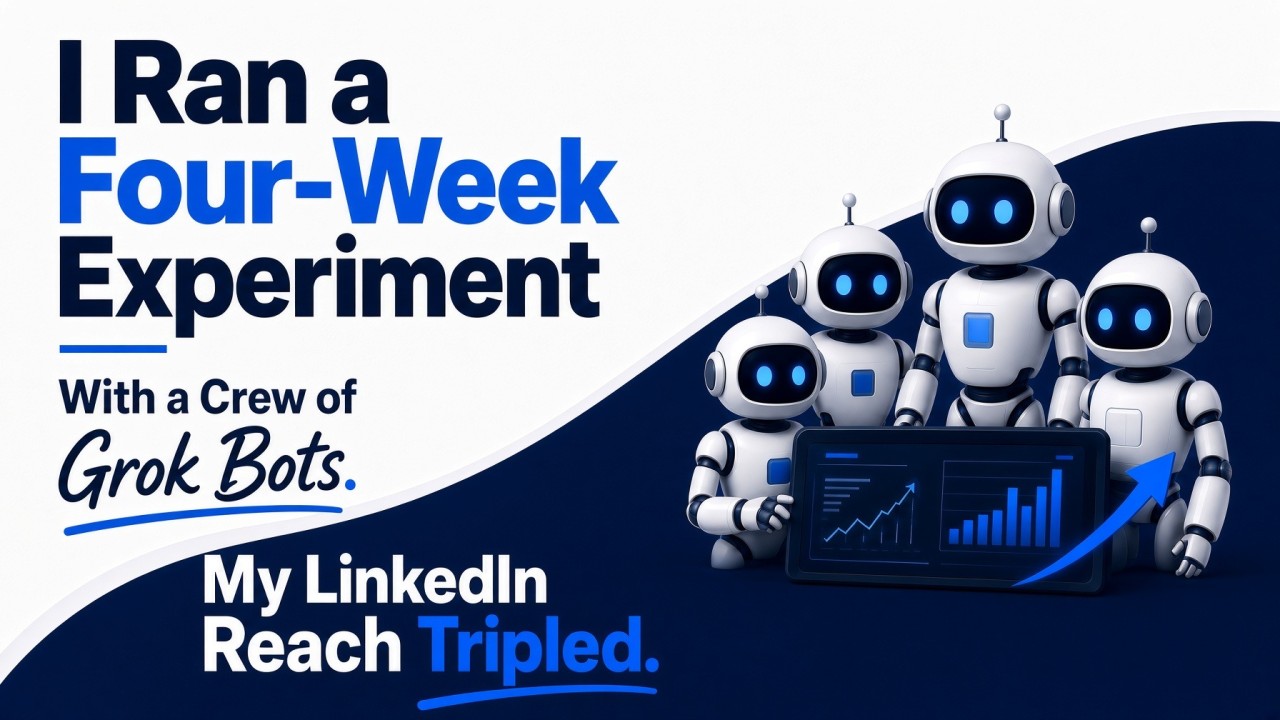
I Ran a Four-Week Experiment With a Crew of Grok Bots. My LinkedIn Reach Tripled.
For four weeks, a crew of Grok bots ran a small online store. Here is what they built, what the numbers showed, and five things I did not expect.
Part of Building in Public
I write a lot about what AI agents will do to finance work. I have argued that human-in-the-loop is a temporary tax, that teams should judge agents by outcomes rather than by how tightly they control them, and that the hard stages of agent work come after assistance. At some point, writing about agents stops counting as evidence. So this fall I ran an experiment.
For four weeks, I gave a crew of Grok bots a small online store and told them to run it. I set the goals and the limits. They did the rest.
Here is what they built, what the numbers showed, and five things I did not expect.
The setup
The store sold a set of AI prompt packs for finance teams. A free pack and paid packs were sold through Stripe. The stakes were small, but the customers and the money were real.
The bots made all of it. They wrote the prompt packs, shaped the offer, and built the store. Everything they used came from what they could find in public sources. My part was to set the goal and say yes or no.
The crew had five Grok bots, each with one job. A CEO agent ran the operation. A website agent owned the site. An X agent and a LinkedIn agent each owned one social account. A search agent owned how people found us through Google, Bing, and Brave.
They all lived in one group chat. Three times a day, the CEO agent posted an ops report covering sales, site health, risks, and a short list of decisions it needed from me. A second model reviewed every report before it went out. That second read matters. If an agent is going to tell me how the store is doing, another model should check the report first.
My job was to read the reports, answer the decision list, and approve anything that would go out under my name.
What the agents built
I gave direction. The agents turned it into a plan and ran it.
The product. The crew researched public material on how finance teams use AI, turned it into three prompt packs, and wrote the copy that sold them.
The engagement playbook. I asked for more engagement. That was the whole instruction. The crew designed the format, which pairs a hard hook with lines you can scan and a close that invites people in. Then they ran two engagement blocks a day on 15 to 20 relevant posts, with replies drafted for my OK.
A business review. A reviewer model looked at the whole operation and came back with four actions. Set up Search Console. Fix the parts of the website that cost it trust. Write outreach templates. Track each step of the checkout. I approved all four, and the crew shipped them.
The site. The website agent built and deployed the site, the shop, and a paywall. After each deploy, it checked every page on the live site. It checked what a visitor would see, not what it meant to ship.
Search. The search agent researched the questions people actually ask, proposed pages to answer them, and got those pages indexed on Google, Bing, and Brave. When Google ignored one page, the agent asked Google to crawl it. Google did, three minutes later.
Volume. In the year before the experiment, I wrote 2 original posts on X. In ten days, the crew published 26.
That last line is the one people react to. It is also the least interesting thing on the list. Any script can post. What struck me was the business review, where an agent found work I had not assigned, and the site agent checked its own work. That is what I have called the Advise stage, and I did not have to build anything special to get it.
The results
LinkedIn is where it showed up. I compared the 28 days of the experiment with the 106 days before it.
- Impressions per day: 48 before, 172 during. About 3.5x.
- Engagements per day: 0.21 before, 0.96 during. About 4.5x.
- Impressions over 90 days rose 462% over the prior 90 days.
- The free pack, on a new website, logged 129 raw downloads.
What surprised me
Volume beat polish on reach. Polish still won on depth.
The crew’s best week hit 2,448 impressions. My best single post is still one I wrote in July.
Both facts hold at once. Posting often, in a format built for the feed, put me in front of more people than I had reached in months. But reach counts how many people saw something. It does not count whether any of them thought about it a day later. The July post worked because it started from something I had seen and believed.
In August, I argued that readers do not punish AI. They punish work nobody cared about. The crew’s posts were not careless. I read every one before it went out. But they were tuned for the feed, and the feed rewards being seen, not being remembered. The crew could gather what was already public and ship it faster than I can. It could not supply a new idea.
Agents can fill the feed. The idea still has to come from somewhere.
Governance sets the pace.
No post or reply went out without my OK. That kept the brand clean. It also made me the slowest part of the system.
In January I wrote that a person who approves every agent decision becomes the delay, not the control. This fall I got to pay that tax myself. When an agent needed a sign-in, an inbox, or a yes, the work waited on me.
Some of that waiting was the point. I want to approve what goes out under my name. But some of it came from things I had never decided ahead of time. Which accounts may the crew use? What may it say without asking? When should it stop and wait, and when should it act and tell me later?
Designing the escalation path matters as much as designing the agent. An agent that knows when to ask is worth more than one that is slightly better at the task.
Identity is infrastructure.
Early on, a few X replies went out from the wrong account. I had approved the words. I had not checked who would say them. Approving the content is not the same as approving the sender.
I had the replies deleted and set one rule. Post only from @chriscouch. The X agent then refused to post until its session matched. That lock worked exactly as designed.
Finance teams are learning the same lesson as agents start to touch money. Each agent needs its own identity, and it needs to check that identity before it acts, not after. A rule written in a chat is a wish. A rule the agent checks before every action is a control.
Stop conditions work.
On Oct 4 I told the crew to ship everything, then stop. They shipped, and they stopped.
That sounds small. It is not. An agent with a goal and no end point will keep finding work, and some of that work will be work you never wanted. Knowing I could say “finish this, then stand down” and trust that it would happen is what made it safe to start. I wrote about why that matters in Stop Conditions Are the Product.
Agents scale output. Buyers still need trust.
The store made one real sale.
Every step before the checkout worked. Reach went up. Engagement went up. The site was live and indexed. Downloads of the free pack nearly quadrupled in a little over two weeks. And one person paid.
Reach is easy to automate. Demand is not. A finance leader who buys a playbook is betting that the person behind it knows something worth paying for. That trust comes from a track record, from people they know, from a name they have seen deliver. This playbook came from bots working from public sources, with no track record behind it. A crew of agents can put an offer in front of more people. It cannot make them believe it.
So I took the store down. I kept the free pack, the essays, and the crew.
What I would tell a finance team
This was a four-week experiment, not an AR operation. But the pattern matches what I hear from finance leaders rolling out agents.
Execution is the easy part now. The agents wrote, built, shipped, checked, and indexed with little help from me. If your rollout stalls, look at the decisions around the work before you blame the model.
Design the escalation path before you design the agent. Decide which actions need a yes, which need a note after the fact, and which need nothing. Write those rules down where the agent can check them. Every rule you leave unwritten becomes a question in someone’s inbox.
Measure the outcome you sell, not the output you make. Twenty-six posts in ten days is output. One sale is the outcome. The first number would have looked great in a board deck. The second one told me the truth.
Why I kept the crew
The store is gone. The crew stays.
The experiment answered the question I cared about. Starting from nothing but public sources, a crew of Grok bots can build a small online store and run its daily work for a month, with one person setting goals and approving what goes out. What it cannot do yet is replace the reasons someone trusts you. That still takes a person, an idea, and time.
If you have handed real work to agents, where did they stall? On the work, or on waiting for you?
Originally published on LinkedIn.
Published .
Cite this
Couch, C. (2026). I Ran a Four-Week Experiment With a Crew of Grok Bots. My LinkedIn Reach Tripled.. Lead to Cash. https://chriscouch.ai/essays/four-week-grok-bots/
BibTeX
@misc{couch2026iranafourweekexperimentw,
  author = {Couch, Chris},
  title = {I Ran a Four-Week Experiment With a Crew of Grok Bots. My LinkedIn Reach Tripled.},
  year = {2026},
  howpublished = {Lead to Cash},
  url = {https://chriscouch.ai/essays/four-week-grok-bots/}
}
Get the Thursday email.
One finding, one data point, one tool, one question.