Stop Conditions Are the Product
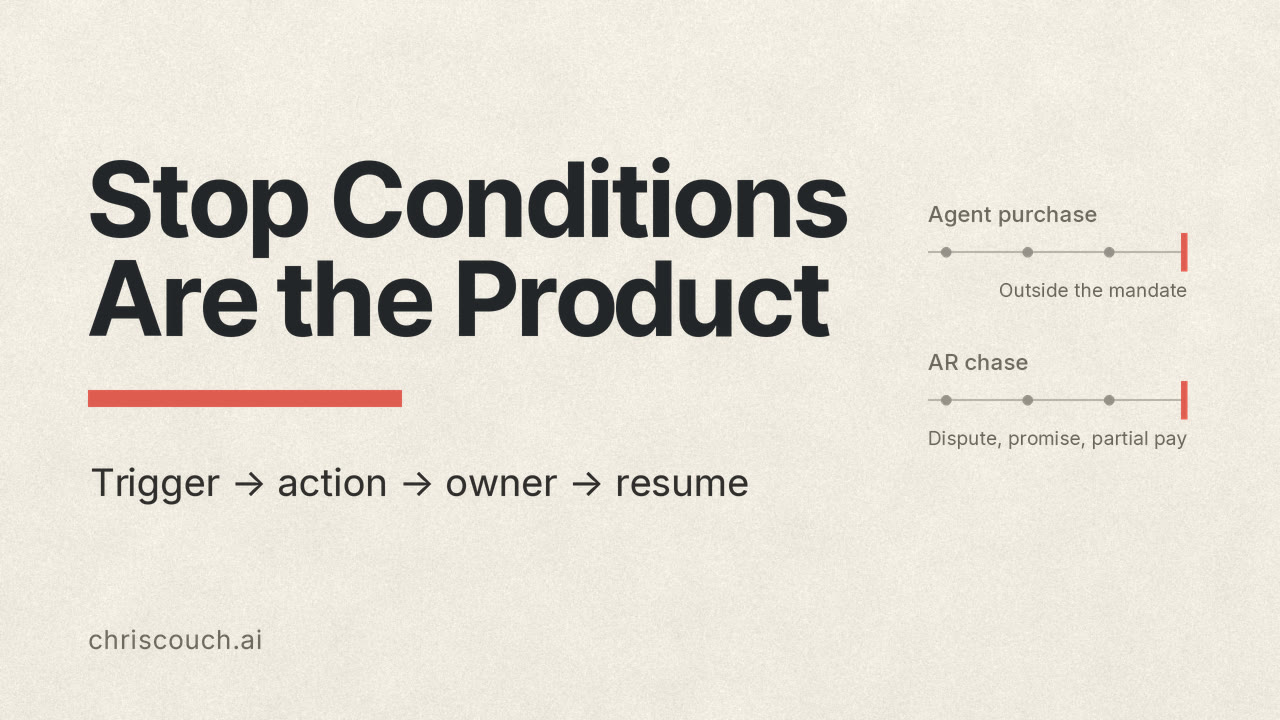
My view is that stop conditions are the product, not a safety review after launch. A stop condition is the rule that tells an agent to halt, escalate, or hand off to a person.
Part of The Management Layer
Earlier this month, Ant International, Mastercard, and Visa started work on a shared way for an AI agent to prove who it is before it pays. None of it tells the agent when to stop.
The industry treats the start as the hard part of agent payments. Identity, consent, and authentication get the press releases. Those controls give an agent permission to act. They don’t write the rule that halts it, and that rule depends on your business, not the network.
My view is that stop conditions are the product, not a safety review after launch. A stop condition is the rule that tells an agent to halt, escalate, or hand off to a person.
The Know Your Agent work covers traceability across networks, shared certification, and continuous transaction monitoring. Mastercard’s Pablo Fourez describes the goal as a way to “verify that actions reflect the user’s intent, and preserve accountability across the transaction.” That work is necessary. It secures the moment the agent starts. Know Your Agent tells a merchant who the agent is. No network can tell your agent when to stop.
The live pilots show the same pattern. On Sep 7 in France, Visa’s test agent paid Cleverbridge with a Revolut card, and a Visa Payment Passkey authenticated the purchase. On Sep 21 in Denmark, an agent booked a coffee tasting on Priceless.com with a Danske Bank Mastercard through Mastercard Agent Pay.
Two write-ups of that Danske payment disagree on whether the person approved the specific purchase. That disagreement is the point. The stop condition is invisible to everyone outside the build team.
Visa lists spending limits, approval workflows, and authentication requirements as controls. The network supplies the controls. The business still sets the values. A passkey proves a person said yes once. It says nothing about the moment the agent must go back and ask again.
Visa says this model “is also being extended to support commercial and B2B payment scenarios.” AR teams already run agents that act. The chase agent fails the same way. It keeps sending after a stop condition fired, because nobody owned the handoff.
When a customer disputes an invoice, the agent must halt the chase and hand the thread to the dispute owner with the customer’s words attached. When a customer promises a date, the agent halts, records it, and resumes only if the date passes without cash. When cash lands short, the agent halts the full-balance chase until an analyst decides whether the gap is a deduction, a short pay, or a dispute. When the email bounces, the agent halts on that contact and hands off the search for the right one.
A chase agent that emails through a dispute puts a wrong answer in writing, with your logo on it.
Every stop condition has four parts: a trigger, an action, an owner, and a resume rule. The trigger is the easy part. The owner and the resume rule are where teams stall.
In a purchase, the trigger is a price, item, or merchant outside the mandate the person approved. The agent halts and goes back for a new yes. The product team that set the mandate owns it, and a fresh passkey approval resumes it. In AR, a recorded promise to pay is the trigger. The agent halts, the collector on that account owns it, and a missed promise date resumes the chase.
This is why I weigh reversibility over accuracy. Accuracy tells you how often the agent is right. The stop condition decides what it costs when the agent is wrong.
If risk owns every stop condition, you get a blanket review queue. If nobody owns it, the agent runs until a customer complains. Product must own stop conditions the way it owns pricing and permissions. They belong in the spec, with versions and measures.
Track how often each stop condition fires, how fast the owner picks up the handoff, and how often the resume rule restarts the agent at the right moment. A review queue stops everything. A stop condition stops the right thing and names who picks it up.
The networks are building the rails for agents to start. The companies that win will ship the stop.
Who owns the stop conditions on your team today? Product, risk, or the AR manager who notices after the third email?
Originally published on LinkedIn.
Defined in the glossary: stop condition
Published .
Cite this
Couch, C. (2026). Stop Conditions Are the Product. Lead to Cash. https://chriscouch.ai/essays/stop-conditions-are-the-product/
BibTeX
@misc{couch2026stopconditionsaretheprod,
  author = {Couch, Chris},
  title = {Stop Conditions Are the Product},
  year = {2026},
  howpublished = {Lead to Cash},
  url = {https://chriscouch.ai/essays/stop-conditions-are-the-product/}
}
Get the Thursday email.
One finding, one data point, one tool, one question.