The Context Layer Is Eating SaaS
The software meltdown isn't AI killing SaaS. It's Christensen's Law of Conservation of Attractive Profits playing out in real time. Value is migrating from the interface layer to the context layer.
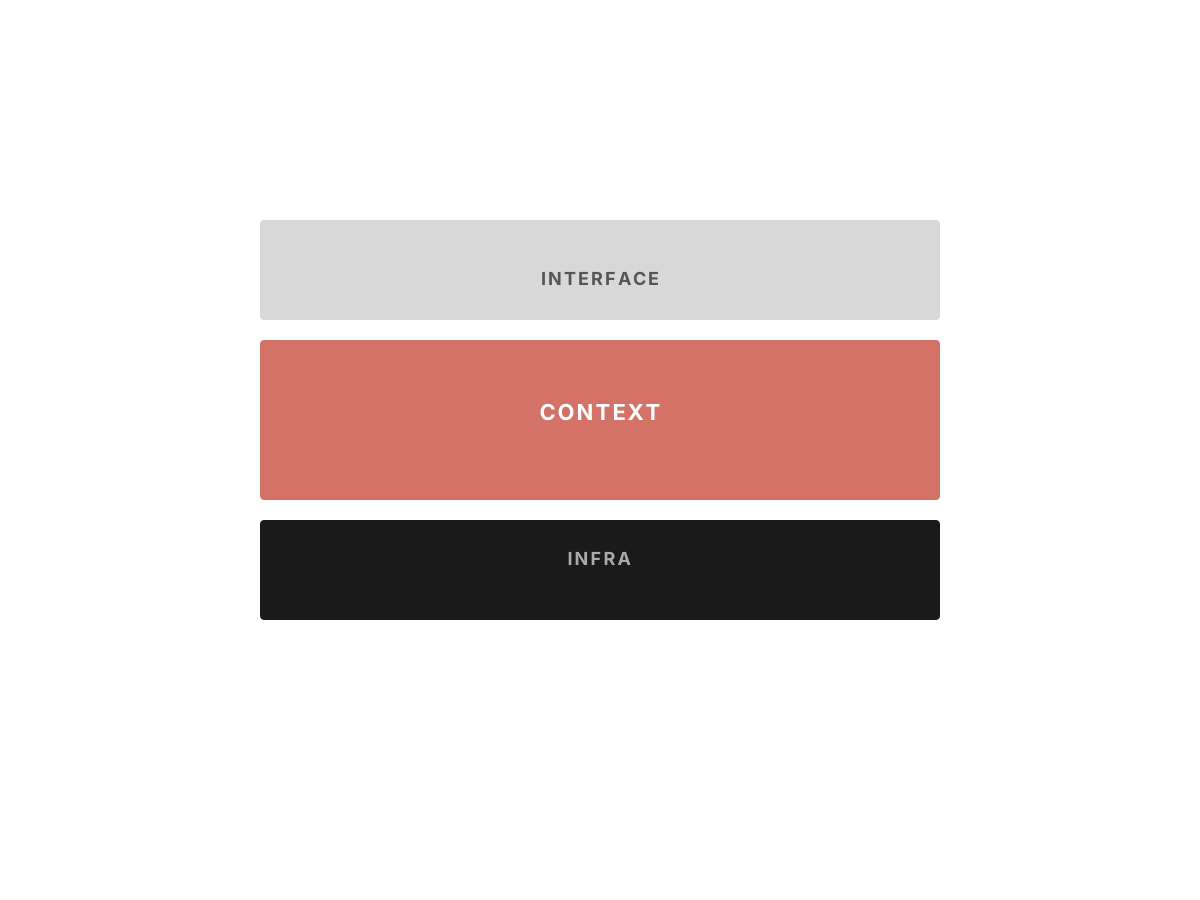
I pulled the 52-week high data on 36 public software companies. Atlassian is down 75%. Figma, 86%. HubSpot, 69%. Monday.com, 80%. Workday, 59%. The headline writes itself: AI is killing SaaS.
Except it isn’t. Not exactly. When I classified each company by what it actually owns, a different pattern emerged. The destruction isn’t uniform. It’s selective. And the selection criteria maps almost perfectly onto a framework Clayton Christensen described decades ago.
What we’re watching isn’t “AI disrupts software.” It’s a value migration between layers of the technology stack, playing out in real time across an entire sector. And most people are misreading where the value is migrating to.
Christensen Had a Law for This
Christensen’s Law of Conservation of Attractive Profits is one of the most underappreciated frameworks in technology strategy. The core idea: when one layer in a technology stack commoditizes, the adjacent layer captures the margin that was lost. Value doesn’t disappear. It migrates.
The classic example is the PC industry. When IBM commoditized hardware by open-sourcing the PC architecture, the profits didn’t vanish. They migrated to the operating system layer (Microsoft) and the processor layer (Intel). Hardware became a commodity. The layers touching hardware became extraordinarily valuable.
This pattern has repeated across every major technology transition. When cloud infrastructure commoditized on-premise servers, value migrated to SaaS applications. When mobile commoditized desktop distribution, value migrated to app ecosystems and attention marketplaces. The profits always go somewhere. The question is always where.
Right now, we are living through the next iteration. AI foundation models are commoditizing the SaaS application layer. And the value is migrating to a layer that most people haven’t named yet: the context layer.
What the Meltdown Actually Reveals
Software Meltdown
36 software companies, ranked by distance from their 52-week highs. The easy read: AI is killing SaaS. Add one lens — does the company own context, infrastructure, or just an interface? — and the pattern changes.
context gap
Classifications by author
Christensen's Law of Conservation of Attractive Profits: when one layer commoditizes, value migrates to the adjacent layer. AI is commoditizing the interface layer. Value is migrating to the context layer: the accumulated operational knowledge that makes AI agents effective in specific domains. The 21-point spread between categories isn't noise. It's a market pricing a structural shift.
Look at the data more carefully. Instead of seeing uniform collapse, ask a different question: why are some companies falling faster than others?
Figma is down 86% from its high. Datadog is down 45%. Both are well-run software companies. Both serve technical audiences. But the market is punishing them very differently. Zoom is down only 13%. Cloudflare, only 3%. Meanwhile Duolingo has cratered 83% and Monday.com 80%.
The pattern isn’t “software is dying.” The pattern is that the market is differentiating between companies that own context and companies that own interfaces. The interface layer is what’s being commoditized. The context layer is where value is migrating.
Consider what Figma actually is. It’s a brilliant interface for collaborative design. But the design artifact itself, the wireframe, the component library, the prototype, is increasingly something an AI can generate. Figma’s value was in making design collaboration frictionless. When AI makes design generation frictionless, the collaboration layer becomes less critical. The interface commoditizes.
Now consider what Datadog owns. It doesn’t own an interface. It owns operational context: the living, breathing record of how your systems behave, what’s normal, what’s anomalous, what correlates with what. An AI agent trying to debug a production issue doesn’t replace Datadog. It needs Datadog. The context is the product.
This distinction, between owning the interface and owning the context, explains most of the variance in the data.
Defining the Context Layer
The context layer is the operational knowledge that makes AI agents effective in a specific business domain. It’s not raw data. It’s not the model. It’s the structured understanding of how a particular business operates, what its patterns are, where its exceptions live, and what its constraints look like.
Think of it this way. A foundation model like Claude or GPT can reason about invoices in general. It understands what an invoice is, what payment terms mean, what a three-way match involves. That’s general intelligence. It’s powerful and it’s rapidly commoditizing.
But to actually process invoices for a specific company, an agent needs to know: which vendors always send invoices with mismatched PO numbers because their system truncates the field. Which customers have informal agreements that override standard terms. Which cost center mappings changed after last quarter’s reorg. Which approvers are on vacation and who their delegates are.
None of that lives in the model. It lives in the context layer. And the context layer is where the value is migrating.
This is Christensen’s law in action. The model layer is commoditizing rapidly. Foundation model prices have dropped 90%+ in eighteen months. The capabilities are converging. The application layer, traditional SaaS, is being squeezed from below by AI that can replicate its features and from above by users who need fewer seats. But the context layer, the operational knowledge that connects generic AI capability to specific business reality, is becoming more valuable with every deployment.
Why SaaS Is the Layer Being Squeezed
The per-seat SaaS model was always a proxy. It didn’t charge for value delivered. It charged for humans who needed access to the software. This worked when humans were the only ones who could do the work. But it contained a hidden assumption: that the ratio of humans to work would remain roughly constant.
AI broke that assumption. When one person with AI assistance can do the work that previously required five people and three SaaS subscriptions, the per-seat model doesn’t just underperform. It actively misaligns the vendor’s revenue with the customer’s value creation. The customer is getting more productive. The vendor is losing seats.
This is why the meltdown isn’t uniform. Companies whose value proposition was “give every team member a tool” are getting destroyed. Atlassian, Asana, Monday.com: their entire business model scales with headcount. When AI compresses headcount, their addressable market shrinks mechanically.
But companies whose value proposition is “we know things about your business that make AI effective” are in a fundamentally different position. Their value increases as AI adoption increases, because every new agent deployment needs context to function.
HubSpot is an instructive case. It’s down 69% from its high, which looks like pure destruction. But HubSpot’s leadership has been quietly repositioning the company as a “source of customer context.” That’s not marketing language. It’s a strategic bet that the CRM’s value isn’t in the interface (which AI can replicate) but in the customer interaction history, the relationship patterns, the behavioral data that no foundation model has access to. HubSpot is trying to migrate from the SaaS layer to the context layer. Whether they succeed is an open question, but they’ve correctly identified where value is heading.
The Three Properties of Context That Create Moats
Not all context is equally defensible. The context that creates durable competitive advantage has three properties.
First, it’s accumulated, not constructed. You can’t build a context layer from scratch. It accumulates through thousands of operational interactions over time. The vendor who has processed your invoices for three years knows your exception patterns, your approval behaviors, your seasonal cash flow rhythms. A new entrant with a better model still starts with zero context. This is why switching costs in context-layer businesses are structural, not contractual. You don’t stay because of a contract. You stay because your context can’t be exported.
Second, it’s specific, not general. General knowledge about “how invoices work” is part of the foundation model. Specific knowledge about how your invoices work is the context layer. The more specific the context, the harder it is for a general-purpose system to replicate. This is the inverse of the SaaS era, where platforms won by being general enough to serve everyone. In the context era, systems win by being specific enough to serve you deeply.
Third, it’s reflexive. Good context layers get better as they’re used. Every transaction processed adds to the pattern library. Every exception handled teaches the system something new. Every decision made refines the model of how this particular business operates. This creates a flywheel: better context produces better agent performance, which produces more transactions, which produces better context. General-purpose SaaS has no equivalent flywheel. Using Asana more doesn’t make Asana smarter about your business.
What This Means for the Software Market
If this analysis is right, the software market isn’t just correcting from pandemic-era excess. It’s undergoing a structural repricing around a new value hierarchy. Let me be specific about what I think the hierarchy looks like.
Layer 1: Foundation Models (commoditizing rapidly). OpenAI, Anthropic, Google, and others are competing on capabilities that converge more every quarter. Prices are in freefall. This layer will be valuable but will look more like cloud infrastructure than like SaaS: high volume, low margin, massive scale requirements. A few winners take most of the market.
Layer 2: SaaS Applications (being squeezed). This is the layer getting destroyed. Traditional applications that primarily provide interfaces for humans to interact with data. The squeeze comes from two directions. From below, foundation models can increasingly replicate core application features. From above, AI reduces the number of humans who need those interfaces. Not all SaaS dies. But the SaaS that survives will be the SaaS that successfully embeds itself in the context layer.
Layer 3: The Context Layer (where value is migrating). This is the operational knowledge layer that connects generic AI capability to specific business reality. Companies that own this layer will capture the margin that SaaS is losing. This layer doesn’t look like traditional software. It looks like deeply embedded operational systems that accumulate institutional knowledge and make that knowledge available to AI agents.
Layer 4: Orchestration and Coordination (emerging). As organizations deploy multiple AI agents across functions, the coordination between those agents becomes its own value layer. This is adjacent to context but distinct: it’s not what the agents know, it’s how they work together. I’ve written about this before in the context of distributed financial intelligence, and I think it becomes a critical layer as agent deployments mature.
The Budget Migration
Here’s the part that matters for anyone building or buying software in this environment. The budget for context-layer systems doesn’t come from the IT line item. It comes from the operational budget.
Traditional SaaS was an IT purchase. You bought Salesforce from an IT budget, justified by replacing legacy systems or enabling new capabilities. The buyer was a CIO or a functional leader with IT’s blessing.
Context-layer systems are an operational purchase. You’re buying the ability to make your AI agents effective at a specific business function. The value isn’t in the software interface. It’s in the operational knowledge the system accumulates. The buyer is the functional leader who owns the outcome, not the IT leader who manages the tool.
This is a significant shift because operational budgets are larger, less centralized, and justified differently than IT budgets. When a CFO buys a context-layer system for accounts receivable, they’re not comparing it to other software. They’re comparing it to the cost of the humans who would otherwise need to provide that context manually. The competitive set changes entirely.
Companies that understand this budget migration will price and sell very differently than traditional SaaS vendors. They’ll sell outcomes tied to operational metrics, not seats tied to headcount. They’ll justify ROI in terms of agent effectiveness, not user productivity. They’ll compete on context depth, not feature breadth.
What Surviving Looks Like
Let me come back to the data and make a prediction. The companies that recover from this correction will be the ones that successfully position themselves as context-layer businesses. The companies that don’t will either be acquired for their data assets or will slowly shrink as their interfaces get replicated by AI.
The tells are already visible. ServiceNow is down 41%, which is painful, but it owns deep workflow context in IT operations that agents need to function. Datadog is down 45% but owns operational observability context. ADP is down 40% but owns payroll and HR context that’s accumulated over decades of processing. These companies have something that a foundation model can’t replicate: specific, accumulated, reflexive operational knowledge.
On the other end: Asana (down 58%) is a task interface. Monday.com (down 80%) is a project interface. Figma (down 86%) is a design interface. Beautiful products, well-executed, loved by users. But interfaces are the layer being commoditized. When an AI agent can manage tasks, coordinate projects, or generate designs, the interface becomes optional.
The strategic question for every software company in this analysis is the same: do you own context, or do you own an interface? If it’s context, invest in making that context available to AI agents. If it’s an interface, figure out what context you can accumulate before the interface commoditizes beneath you.
The Uncomfortable Implication
There’s a version of this analysis that’s comforting to incumbents. “Just add AI to your existing product and you’ll be fine.” That’s the message most enterprise software companies are telling their boards right now.
It’s wrong, and Christensen would have recognized why. When value migrates between layers, the companies best positioned to capture it are rarely the incumbents in the commoditizing layer. Microsoft didn’t win operating systems because IBM decided to make software. It won because it understood the new value layer better than the company defending the old one.
The companies that will own the context layer in enterprise software may not be the companies that own the SaaS layer today. They might be companies that have been quietly accumulating operational context without anyone recognizing it as a strategic asset. Payroll processors. Payment networks. Industry-specific workflow systems. Companies that have been processing transactions for years and have accumulated deep knowledge about how their customers actually operate.
The meltdown data shows which companies are losing value. The more interesting question is which companies, some of them not yet on anyone’s watchlist, are positioned to capture it.
Value doesn’t disappear. It migrates. The only question is whether you’re standing where it’s going.