What a Reconciliation Agent Can Explain, and What a Person Signs
Can an AI agent reconcile accounts and explain variances? It can match, propose fixes and draft notes with source links. A person still signs the reconciliation.
Can an AI agent reconcile an account and explain the variances? Yes. It can match transactions, sort what did not match, propose a fix for each exception and draft the variance explanation with links to the source entries.
A person still signs the reconciliation. The control that matters is a stop condition. When the agent cannot trace an explanation to a real entry, it marks the variance unexplained and hands it to the account owner. Judge the agent by how fast its errors get caught and undone, not by its match rate.
Most advice on reconciliation agents says to judge the agent by its match rate. That misses what makes a reconciliation agent dangerous. Match rate measures how often the agent is right. It says nothing about what a wrong answer costs.
In reconciliation, the costly wrong answer is not a missed match. A missed match sits in the unmatched pile, where a person will look at it. The costly wrong answer is a confident explanation that hides a misposting, because that error travels up to the reviewer looking finished.
This is the sister piece to what a cash application agent can post. That essay covers what an agent posts in AR. This one covers the reconciliation and the variance sign-off that sit on top of it.
What can an AI account reconciliation agent do today?
The products are real, and narrower than the launch copy suggests. Three examples show the current shape. Two of them come from Microsoft, which ships two separate agents, one inside Excel and one inside Dynamics 365 Finance.
How does an agent match a bank statement to the ledger?
Microsoft’s Financial Reconciliation agent in Excel takes two tables, such as a bank statement and a general ledger export. It suggests the keys to match on, and the accountant accepts them or sets their own, including partial matches and amount tolerances. The report sorts every line into matched, potentially matched and unmatched. Each line carries an ID that traces it back to its source row (Avantiico).
That source trace is the part worth paying attention to. A match without a trail is a claim. A match with a trail is evidence a reviewer can test.
What does the Dynamics 365 Account Reconciliation Agent do?
Inside Dynamics 365 Finance, the Account Reconciliation Agent handles two exception types today: voucher amount mismatch and pending accounting transferred to general ledger. For each exception it recommends one action, such as Create journal entry. The accountant accepts it or picks Reverse, Link transactions or Accept without change. In Avantiico’s words, “The decision stays with them.” Microsoft ships the agent as a preview, and its documentation is marked prerelease (Avantiico).
One detail matters more than the rest. The Activity pane records what the agent suggested and what was reconciled, and a reconciled item can be undone. That is reversibility built into the product.
What do close suites like Safebooks and Meridian claim?
Safebooks launched a close and finance operations suite in October. Its release says AI agents “prepare reconciliations, validate transactions, investigate differences and assemble supporting workpapers,” while “Finance teams review exceptions and retain control over judgments and approvals” (PR Newswire).
Pilot’s Meridian, built for accounting firms on QuickBooks Online, runs the close before an accountant sees it. Before a close reaches review, Meridian “performs flux analysis, surfaces exceptions.” A close counts as done only when “The accountant has reviewed, approved, and delivered” the package (GlobeNewswire).
Three vendors, one pattern. The agent prepares. A person approves.
What can the agent match and explain on its own?
The agent has a clear lane. It matches items with a clear key and amount, and it logs the source of each match. It groups possible matches, one-to-many and many-to-many, and shows the candidates. It proposes a fix for each exception. It drafts the variance note, and every number in that note cites a source entry by journal entry number, date, and vendor or customer. Sign-off never moves to the agent.
| Work item | Agent does | Person does |
|---|---|---|
| Clear match on key and amount | Match and log the source | Spot-check in review |
| Possible match (one-to-many, many-to-many) | Group and show candidates | Accept or reject |
| Unmatched item | Flag and assemble the trail | Investigate and decide |
| Exception with a known fix | Propose the fix | Accept, change or reject |
| Variance with traced source entries | Draft the note with links | Review and approve the note |
| Variance with no traced source | Mark it unexplained | Investigate |
| Accruals, cutoff, judgment calls | Surface candidates only | Decide |
| The reconciliation as a whole | Prepare the workpaper | Sign off |
When must a reconciliation agent stop and hand off?
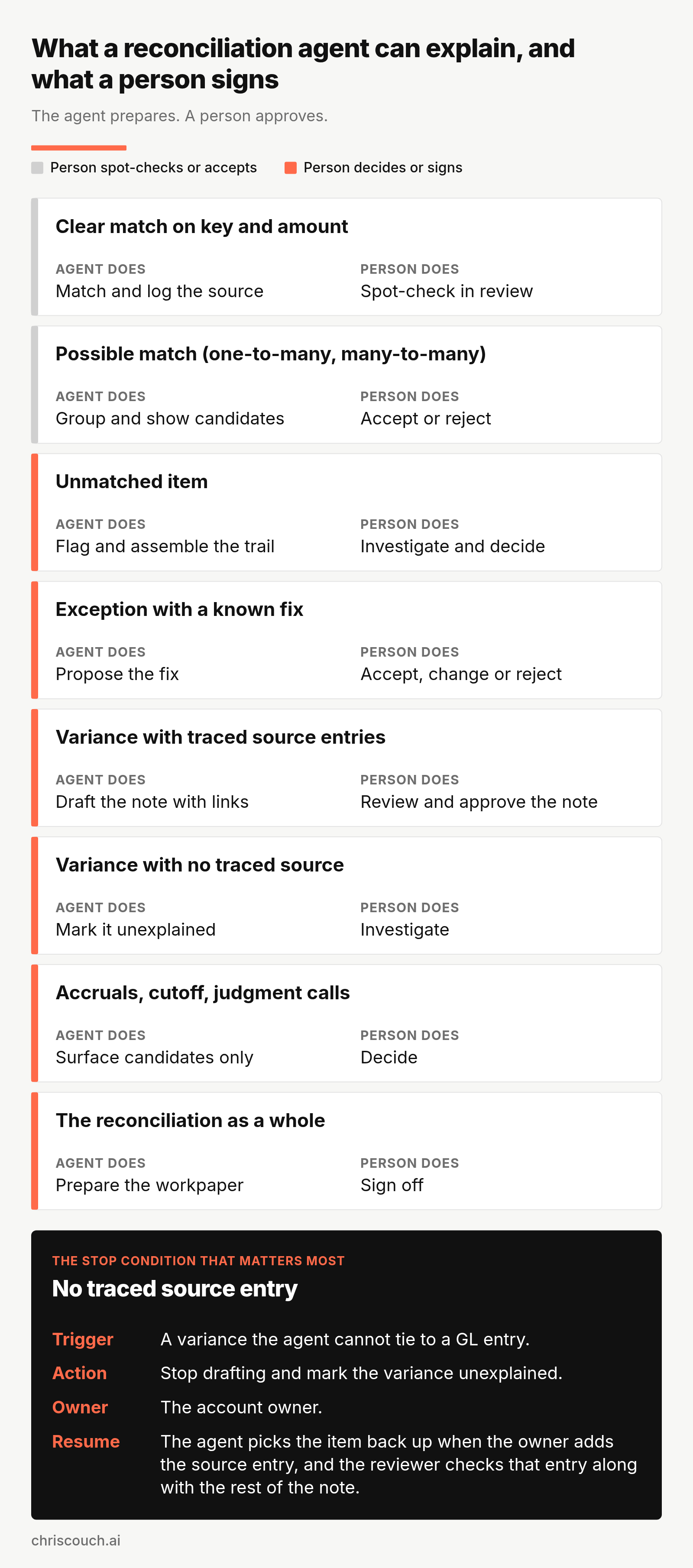
The table is a list of stop conditions. As I argued in Stop Conditions Are the Product, each one needs four parts: a trigger, an action, an owner and a resume rule.
The most important one is “no traced source entry.” The trigger is a variance the agent cannot tie to a GL entry. The action is to stop drafting and mark the variance unexplained. The owner is the account owner. The rule to resume is simple. The agent picks the item back up when the owner adds the source entry, and the reviewer checks that entry along with the rest of the note.
The second covers a possible match the agent cannot settle. The trigger is a candidate group with no exact key match. The action is to hold the group in potentially matched. The owner is the preparer, and the agent resumes when the preparer accepts or rejects the group.
The third covers an account on the always-review list. Cash, suspense, clearing and intercompany accounts are common entries. The trigger is any activity on a listed account. The action is draft only, with no proposed fix applied. The owner is the controller, and nothing moves until the controller signs.
What does a person still sign off on?
A person signs the reconciliation itself. A person also signs every accepted fix, every explanation on an always-review account, every accrual and cutoff call, and everything the agent marked unexplained.
The agent is the preparer of record, under its own identity. Never a borrowed login. Microsoft recommends a dedicated agent identity for the Dynamics agent (Avantiico), and the case for it runs deeper than one vendor’s setup guide. I made it in Your AI Agents Need an HR Department. The reviewer is a named person. That split is what makes the workpaper auditable.
Can you trust an AI-written variance explanation?
You can trust one that passes a test. You cannot trust one because it reads well.
Why is a plausible explanation the dangerous failure?
One anecdote makes the point. A commenter on r/Accounting who ran the close for a multi-entity group described their experience this way: “One month it wrote a beautiful explanation for a variance that was just a misposting, and we almost sent it up before someone caught it” (r/Accounting thread). That is one person’s story, not data. It still describes the failure exactly.
The explanation was well written, it was wrong, and it looked done. You do not have to take their word for it. The planted-error test at the end of this essay lets you reproduce the failure on your own ledger in an afternoon.
A language model is built to produce a fluent answer. Ask it why an account moved and it will give you a reason. The control has to come from outside the model.
What makes an explanation count as explained?
Three tests. The cited amounts add up to the change. Every cited item exists in the GL. Errors are called errors, with a correcting entry, and never explained away as business activity. An explanation that fails any test is unexplained, whatever it says.
Is match rate the right way to judge a reconciliation agent?
No. My position is reversibility over accuracy. An agent that is right more often but hides its rare error behind a clean sentence costs more than one that is wrong more often and flags every miss.
The Autonomy Tax is the cost of catching and undoing what the agent got wrong. Measure that instead. How often do planted or real errors get flagged as errors? How fast does the owner pick up an unexplained item? Can every accepted fix be undone?
This also changes where review time goes. A reviewer who clicks through hundreds of clean matches adds no control. That is the human-in-the-loop placebo. Spot-check the clean matches and spend the hours on exceptions and unexplained items, which is where a person in the loop earns their keep.
What does the agent need to know that is not in the ledger?
Balances, entries and bank statements sit in the ERP and the bank, so the agent pulls them live. Copies go stale.
The rest has no system of record. Why one accrual account swings every Q4. Which vendor mis-codes freight every month. Which accounts always need a person.
That knowledge lives in the heads of the close team, and the team must write it down where the agent can read it. That is the split I describe in Your Agent Needs Two Memories. An agent that pulls everything and keeps nothing will explain the Q4 swing from scratch every year, and sometimes wrongly.
Does this change the close calendar and the team?
Yes, in the shape of the work more than its length. Avantiico expects reconciliation to move into the month, with the close window left for review and sign-off (Avantiico). That is a vendor’s expectation, not a measured result, but it matches how the stop conditions above play out. The agent matches and drafts as entries post. People review and sign at month end.
The team does not disappear. It splits. Some people teach the agent the rules and the exceptions. Others make the judgment calls and sign.
What will auditors ask about an AI reconciliation agent?
Avantiico lists the questions, and they are the right ones (Avantiico). Who is the agent, and does it have its own identity? Who accepted each action it proposed? Where does the activity record live? How do you handle model updates?
Microsoft notes that it can update the underlying AI model automatically, so a model change belongs in change management, followed by a fresh round of the planted-error test below. Have those four answers written down before the first live close.
How do you test a reconciliation agent before a live close?
Most setup guides say to clean your data first. Avantiico puts it plainly: “Clear the backlog first.” Do not wait for that. Cleaning data before you start is the Preparation Trap, and it delays the learning you need. Run the agent on a closed month now, learn from the gaps, then widen.
Pick a month you already closed and reviewed, so you know the right answers. Plant known errors: a miscoding, a duplicate, and a misposting between two balance sheet accounts. Run the agent unchanged. Then score it. Which errors came back flagged as errors, and which got a plausible business explanation instead? The second kind is the one that matters.
The planted-error method comes from nocodetalks.co, which publishes a sample answer key. Their own note says nobody ran it. Treat it as a method, not a result. Rerun the test whenever the prompt, the setup or the model changes.
Defined in the glossary: close readiness
Published .
Cite this
Couch, C. (2026). What a Reconciliation Agent Can Explain, and What a Person Signs. Ends at Cash. https://chriscouch.ai/essays/ai-account-reconciliation-agent-gates/
BibTeX
@misc{couch2026whatareconciliationagent,
  author = {Couch, Chris},
  title = {What a Reconciliation Agent Can Explain, and What a Person Signs},
  year = {2026},
  howpublished = {Ends at Cash},
  url = {https://chriscouch.ai/essays/ai-account-reconciliation-agent-gates/}
}