Can an AI Collections Agent Offer a Payment Plan, and When Does a Person Take Over?
Can an AI agent offer a payment plan or take a promise to pay? Yes, from your policy table. Here is when it stops and hands the account, or the call, to a person.
Yes. An AI collections agent can offer a payment plan and take a promise to pay, as long as every option comes from a policy table you wrote and the agent reads every amount from your AR system. It records each promise with a date and checks for the cash on that date. It stops and hands the account to a person when the customer disputes, asks for terms outside the table, asks for a human, or breaks a promise twice, or once on an account you flagged.
A policy table is a short list of the plans, terms and fee waivers you already allow, written down before the agent sends anything. The rule behind this piece is simple. Give the agent room where a mistake is cheap to undo. Hold it to the table where a mistake is not. The stop condition table near the end puts that rule in one place, with an owner and a resume rule for each row.
A recent r/Accounting thread captures the reader I have in mind (Reddit). One poster runs AR on a two-person team with net 30 and net 60 customers. They are tired of sending the same reminder over and over, and they want time back without hurting the customer experience. That is one anecdote, not a survey. It is also the trade most collections teams weigh right now.
Vendors answer it with volume. Transformance says its calling agent, Vero, makes “15-20 calls an hour in 70+ languages” (Transformance). PayNearMe says that in one pilot its agent placed as many calls in an hour as about 28 support staff (PayNearMe). Both are vendor claims. Both measure touches.
Volume says nothing about what happens when the agent is wrong. In collections, the costly wrong answer is not a missed call. It is an offer the business never agreed to, a made-up amount, or a chase that keeps going after the customer disputed, promised or asked for a person. A call makes it worse. The agent says the wrong answer out loud, on a recorded line, with your company’s name on it.
One note on sources. Some of the products below serve consumer lenders, where hardship claims and settlement offers are routine. PayNearMe and Zolva work that side.
Others, such as Cord and Transformance, serve B2B teams, where the hard cases are disputes, short pays and the wrong contact. I flag which is which, because the mechanics carry over and the vocabulary does not. If you need the basics first, start with what an AI agent for accounts receivable is. This piece covers offers, promises and calls only.
Can an AI agent offer a payment plan?
Yes, inside limits you wrote down before the first call. Three products show where the market sits today. Oracle’s 26D release adds Fusion Claw to the Collector Workspace. Oracle says it “Recommends and automatically executes the appropriate next-best collection action,” under the controls, approvals and thresholds each customer configures.
The same release reads promise to pay intent in collector call notes and records the commitment. Oracle scheduled it for customer uptake in November 2026 (Oracle). Transformance’s Vero emails, calls and records promises to pay against the invoice (Transformance). Cord’s agent drafts reminders and can propose an installment plan. It starts in an approval mode, so nothing goes out until a person signs off (Cord).
Which plans can it offer without a person?
Only the options in the policy table. That table lists the number of installments, the longest term, and any fee waiver you already allow. Resolve Pay puts it plainly: “Within predefined guardrails, AI agents can offer and process payment arrangements” (Resolve Pay).
Cord shows what that looks like in a product. Its agent proposes a plan “that only the customer can accept.” Cord calculates the installment amounts itself, and the agent cannot invent them (Cord). Zolva makes the same design point for voice. Settlement percentages, term lengths and fee waivers are configuration with hard limits, and anything outside them routes to a human (Zolva).
The reason is reversibility. A drafted email costs nothing to discard. A plan the customer has accepted is a commitment you must honor or retract in front of them. That is the Autonomy Tax. Give the agent freedom where the action is cheap to undo, and hold it to the table where it is not.
Who decides terms outside the table?
The credit manager or collections lead who owns the account. The agent assembles the case: the balance, the payment history, prior promises and the customer’s own words. Then it stops. It does not counter, discount or improvise. It also cannot write off a balance, settle a dispute or change credit terms.
How does an agent track a promise to pay?
It records the date and amount against the invoice, pauses the chase, and checks for cash on that date. Transformance describes the loop. When a customer promises, its system schedules a check by call or email on the committed date. If the promise breaks, the account’s priority score rises and it escalates (Transformance). Oracle’s 26D release captures promise intent from call notes, so a promise made to a person on the phone still lands in the record (Oracle).
Products differ on the default. In Cord, a promise does not pause the agent on its own. You add the account to its Never email list to pause it (Cord). Check this default in any product you test, and decide which behavior you want. My view is that the chase pauses on a fresh promise, because a reminder that lands after the customer committed tells them nobody listened.
This is the model stop condition. The trigger is a recorded promise to pay. The action is to halt the chase. The owner is the collector on that account. The resume rule is a promise date that passes without cash.
When does a broken promise go to a person?
What counts as broken?
No cash on the date, or less cash than promised. Partial cash is its own case. The agent stops the full-balance chase, and an analyst decides whether the gap is a short pay, a deduction or a dispute. The cash application essay covers what the agent posts when that partial payment lands.
Does the agent chase again or escalate?
It depends on the account, and you set the count. On a routine account, a first broken promise can resume the chase with the next, firmer step. A repeat broken promise, a high balance, or any account the team has flagged goes to a person, who calls. I will not give you a number for “repeat.” Your history decides it, and the policy table records it.
What can an AI voice agent say, offer and record on a collections call?
It can say, offer, and record the same things it can by email. It has less room to fix a mistake after the fact.
What must it say first?
That it is AI. Transformance says Vero identifies itself as AI at the start of every call (Transformance). Zolva treats disclosure and caller identification as fixed text, spoken before the model gets the turn, on the grounds that a model asked to paraphrase a required disclosure will paraphrase it (Zolva).
Where do amounts come from?
From the system of record, every time. Zolva’s rule is “Amounts are read, never computed” (Zolva). Resolve Pay says the same. Every balance, invoice number and due date must come from the ledger at call time (Resolve Pay).
Two kinds of memory sit behind that rule. Balances, due dates and open promises live in the ERP or AR system, so the agent pulls them live. Why this customer always pays on the 15th, or what nearly cost you the account last year, has no system of record. The team writes that down for the agent.
What can it offer and record?
Only table offers. It records promise dates, dispute reasons, contact changes and opt-outs, with a transcript. PayNearMe, whose agent serves consumer lenders, lists capturing promises to pay and managing opt-outs among its actions (PayNearMe). Resolve Pay’s sample script maps “Stop calling me” to an opt-out and a stated dispute to a pause and the dispute queue (Resolve Pay).
When does it hand the call to a person?
On a dispute, a hardship claim, any mention of a lawyer or bankruptcy, a request for a human, or a wrong contact. Zolva calls these deterministic handover triggers (Zolva). The transcript goes with the call so the customer does not repeat themselves. PayNearMe describes connecting the customer with support staff when needed (PayNearMe). In B2B, the hardship row matters less and the wrong-contact row matters more. The AP clerk who answers can be someone who does not own the invoice at all.
Do B2B collection calls have the same rules as consumer calls?
Not the same rules, and not zero rules. Resolve Pay’s summary is that B2B trade receivables generally fall outside the FDCPA. TCPA consent, state collection rules and call recording laws can still apply. The FCC confirmed in February 2024 that AI-generated voices count as artificial or prerecorded voice under the TCPA (Resolve Pay). This is not legal advice. Take your calling plan to counsel before the first live call.
How do you write the stop conditions for collections?
One row per situation, each with an owner and a resume rule. The stop condition entry has the definition. Stop Conditions Are the Product has the argument. Here is the table for offers, promises and calls.
| Situation | Agent does | Owner and resume rule |
|---|---|---|
| Customer asks for a plan inside the policy table | Offers table options, records acceptance | None. Logged |
| Customer asks for terms outside the table | Assembles the case, stops | Credit manager decides, agent resumes on the new terms |
| Customer promises a date | Records date and amount, pauses chase | Collector on the account owns it, resumes if the date passes without cash |
| Promise broken, routine account | Resumes with the next step | Collector reviews per your count |
| Promise broken again, high balance, or flagged account | Stops | Collector calls |
| Partial payment on a promise | Stops the full-balance chase | Analyst decides short pay, deduction or dispute |
| Dispute stated | Pauses, routes with the customer's words | Dispute owner, resumes when the dispute is closed |
| Hardship, lawyer or bankruptcy mentioned | Ends the offer, hands off | Collections lead |
| "Talk to a person" | Transfers with transcript | Collector |
| Wrong contact or "stop calling" | Ends call, records opt-out or contact change | AR specialist finds the right contact |
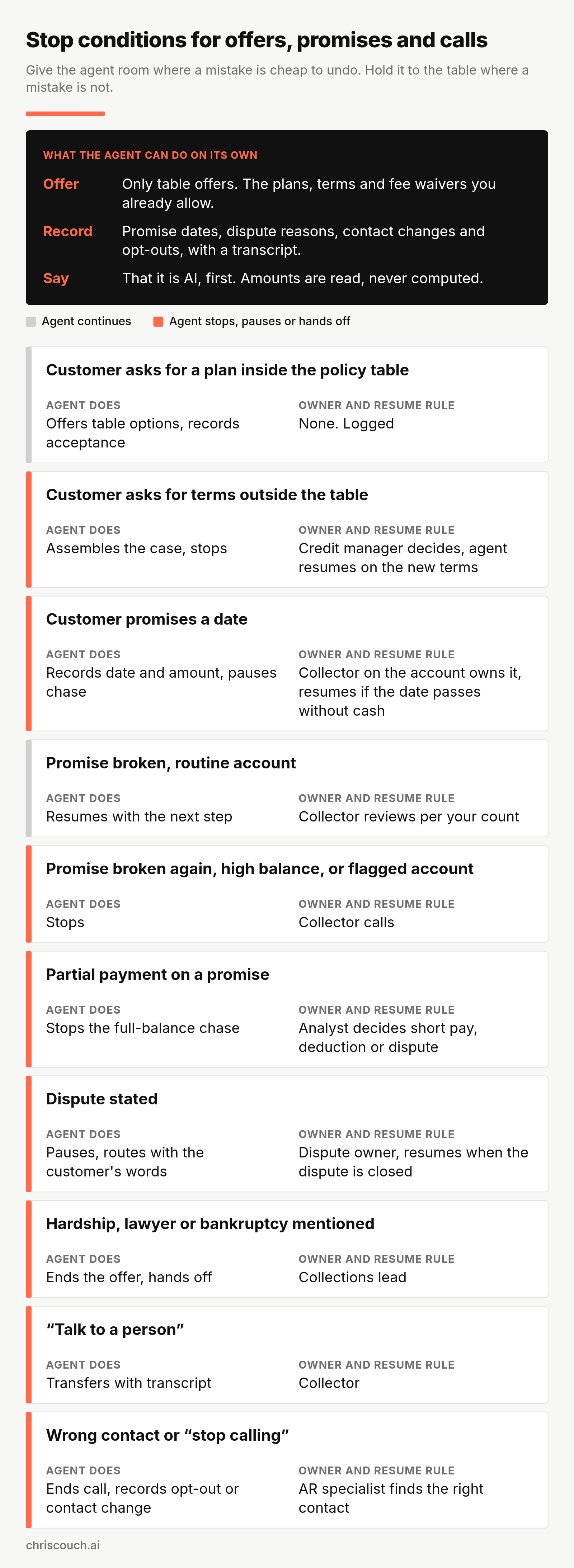
Notice what the table leaves out. Nobody approves each routine reminder. Approving every email feels safe and catches little, which is the human-in-the-loop placebo. Put the person at the rows where a wrong answer is hard to take back.
How do you judge a collections agent if not by call volume?
By what it costs when it is wrong, and how fast you catch it. I weigh reversibility over accuracy. Four measures matter. Track how often each stop condition fires.
Track how fast the owner picks up the handoff. Track how often a resumed chase restarts at the right moment. Track how many accepted offers you had to retract.
None of these show up in a calls-per-hour chart. All of them show up in the customer relationship. Reminder volume and days sales outstanding still matter. They measure the outcome, not the control.
Does this replace collectors?
No. The work moves to the judgment calls: disputes, partial payments and terms outside the table. The agent takes the reminders and the routine promises. The people take the moments that decide whether the customer stays.
Related: the four stages of agent evolution, Your Agent Needs Two Memories, Your AI Agents Need an HR Department, and the AR automation market report.
Published .
Cite this
Couch, C. (2026). Can an AI Collections Agent Offer a Payment Plan, and When Does a Person Take Over?. Ends at Cash. https://chriscouch.ai/essays/ai-collections-payment-plan-promise-to-pay-gates/
BibTeX
@misc{couch2026cananaicollectionsagento,
  author = {Couch, Chris},
  title = {Can an AI Collections Agent Offer a Payment Plan, and When Does a Person Take Over?},
  year = {2026},
  howpublished = {Ends at Cash},
  url = {https://chriscouch.ai/essays/ai-collections-payment-plan-promise-to-pay-gates/}
}